Why Next.js Is Important for Business Websites in 2026
Why Next.js Is Important for Business Websites in 2026
What worked five or ten years ago doesn't always work today.
In 2026, businesses aren't just competing through better products, lower prices, or stronger service anymore. They're competing for attention.
When a competitor's website is faster, easier to navigate, and more visible on Google, they may reach your potential customers before you do.
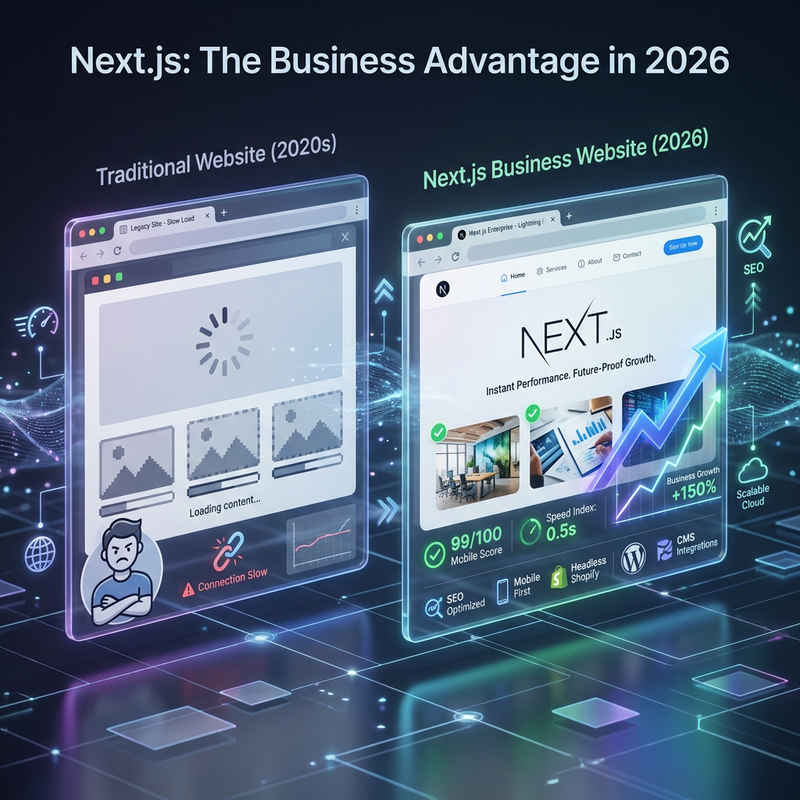
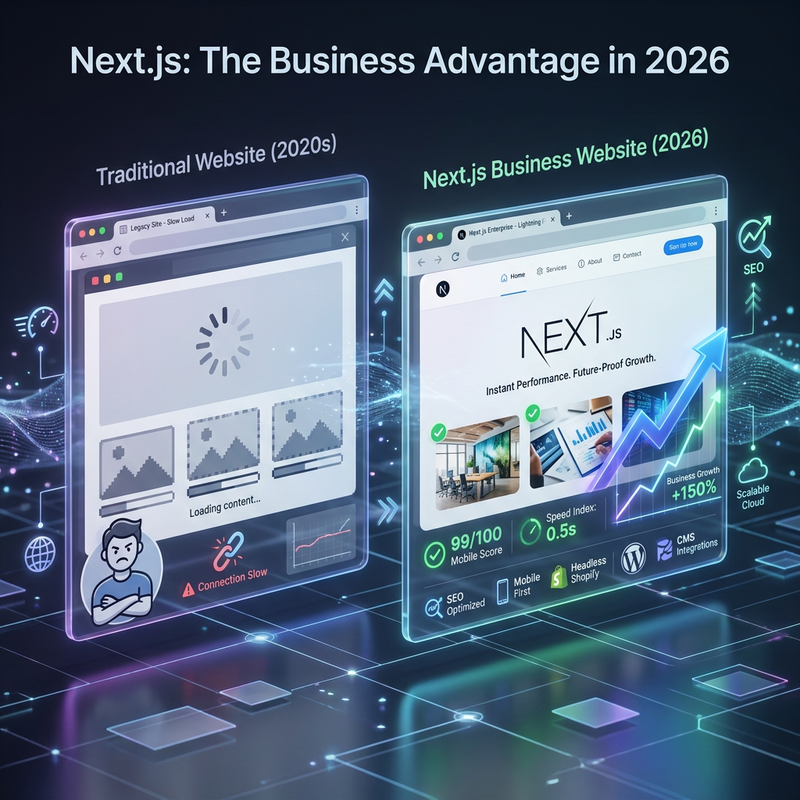
Research consistently shows that many mobile visitors abandon a website if it takes more than a few seconds to load. That means a slow website can lose potential customers before they ever see your product, service, or message.
Lost visitors become lost traffic. Lost traffic becomes lost leads. And lost leads eventually become lost revenue.
Simply having a website isn't enough anymore. Your website is now a core business tool that directly shapes customer trust, brand perception, search visibility, user experience, and sales. That's a big part of why Next.js has become one of the go to technologies for website development in 2026.
Why Next.js Provides a Stronger Foundation for SEO
A beautiful website is only valuable if people can actually find it. Many traditional websites lean heavily on client side JavaScript to display content, which can make it harder for search engines to see what's really on the page. Next.js takes a different approach, delivering key page content directly in the initial HTML through Server Side Rendering (SSR) and Static Site Generation (SSG). That makes it easier for search engines to crawl, understand, and index your pages, while visitors get to see content sooner too.
Beyond rendering, Next.js gives you the technical foundation modern SEO actually requires. Every page can have optimized titles, meta descriptions, canonical URLs, structured data, Open Graph tags, XML sitemaps, and clean, semantic HTML. Combine that with fast load times, responsive design, and strong Core Web Vitals, and you get a site that's easier for both users and search engines to navigate.
Unlike many websites built on plugin heavy platforms, Next.js bakes in a lot of performance and SEO best practices by design, cutting down on unnecessary code and giving developers real control over optimization. It won't guarantee a #1 Google ranking; no technology can promise that. High quality content, keyword strategy, and backlinks still matter just as much. But Next.js gives your SEO efforts a modern technical foundation to build on, setting your business up for stronger long term organic growth.
Why Traditional Website Platforms Can Become Limiting
Platforms like WordPress, Webflow, Wix, and Squarespace make it easy to launch a website, which is exactly why they remain popular for small businesses and simple projects.
But as a site grows, these platforms can become harder to optimize for speed, SEO, and long term scalability. Adding plugins, third party scripts, apps, and custom features tends to increase complexity over time, and that complexity often chips away at performance, Core Web Vitals, and the overall user experience.
Next.js was built to solve exactly these problems. It delivers stronger performance, a solid SEO foundation, more flexibility, and the kind of scalability businesses need to grow, without the ceiling that traditional website platforms tend to put on you.
How Next.js Helps Websites Load Faster
Instead of making the browser build each page after a visitor clicks, Next.js prepares and delivers content in advance using techniques like Server Side Rendering (SSR), Static Site Generation (SSG), smart caching, and global CDNs.
It also handles a lot of the optimization automatically: compressing images, loading the right fonts and scripts efficiently, trimming unnecessary JavaScript, and even preloading linked pages in the background before a visitor clicks them. The result is a site that loads faster, feels more responsive, and holds up well across both desktop and mobile, which keeps visitors engaged instead of bouncing to a competitor.
Next.js Gives You Greater Control Over the Customer Experience
A modern website should do more than display information. It should guide visitors toward becoming customers. Many website builders and template based platforms are designed to work for almost any business, which is convenient, but it also means they limit how far you can push customization, performance, and scalability.
Next.js flips that. It gives developers complete control over every part of the customer experience, so you can build a website tailored to your business instead of forcing your business into a template.
Whether it's a high converting landing page, an eCommerce store, a booking system, a customer portal, a membership platform, a dashboard, or custom business integrations, Next.js makes it possible to build something faster, more interactive, and genuinely personalized. As your business grows, your website can grow with it, without running into the walls that traditional platforms tend to put up. The end result is a site that not only looks professional but also drives more engagement, more conversions, and a real competitive edge.
Next.js Works With Shopify, WordPress, and the Tools You Already Use
One of the best things about Next.js is that you don't have to rip out your existing website or business systems to benefit from it. Instead of starting from scratch, Next.js can work alongside platforms like Shopify, WordPress, Webflow, Sanity, Strapi, and Payload, letting you keep the tools your team already knows while dramatically improving speed, SEO, flexibility, and user experience.
Shopify + Next.js (Headless Shopify)
If you're already using Shopify, there's no need to migrate your products or store management. Shopify keeps handling the things it's good at:
- Products
- Inventory
- Orders
- Payments
- Customers
- Discounts
Meanwhile, Next.js powers the customer facing storefront, delivering a faster, more responsive shopping experience with better SEO and far more design freedom. This setup is commonly known as Headless Shopify, and it combines Shopify's strong backend with the performance and customization Next.js brings to the front end.
WordPress + Next.js (Headless WordPress)
The same idea applies to WordPress. Your team keeps publishing blog posts, updating pages, and managing content through the WordPress dashboard they already know, while Next.js serves that content through a modern, high performance front end. You get the best of both: an easy to manage CMS paired with a faster, more scalable website.
The same concept extends to modern headless CMS platforms like Sanity, Strapi, Payload, and others. Next.js doesn't replace your existing systems. It enhances them, giving your customers a faster, more engaging experience while letting your business keep the tools it already relies on.
[Internal link suggestion: link "Headless Shopify" and "Headless WordPress" mentions above to your relevant service pages, if you have them.]
A Website That Grows With Your Business
Your website shouldn't be the thing holding your business back. Many template based platforms become harder to extend over time, often requiring extra plugins, awkward workarounds, or eventually a full rebuild just to add a new feature.
Next.js is built to scale from day one. A simple marketing site can evolve into an eCommerce store, a booking platform, a customer dashboard, a membership portal, a marketplace, or even a full web application, all without swapping out your entire tech stack.
As your business grows, adding new products, locations, languages, integrations, or customer features becomes far easier. Instead of rebuilding your website every few years, you keep building on the same modern foundation. That's the real reason many businesses choose Next.js, not just for the website they need today, but for the one they'll need tomorrow.
Better Website Performance Can Support Business Growth
A modern website should do more than look good. It should help your business grow. Faster load times keep visitors engaged, a smoother experience builds trust, and a solid technical SEO foundation makes it easier for potential customers to find you in the first place. Combine that with more flexibility and scalability, and Next.js becomes a platform that performs well today while staying ready for whatever comes next.
Many businesses that have migrated to Next.js or similar modern architectures report real improvements in performance, Core Web Vitals, organic traffic, engagement, and conversions. Next.js alone won't guarantee business growth, but it gives you the technical foundation to support it. Paired with strong content, effective marketing, and a clear business strategy, it becomes a powerful platform for attracting more visitors, generating more leads, and growing revenue online.
📖 Read the Case Study: Discover how leading companies benefited from adopting Next.js. https://www.xsatec.com/blog/how-leading-companies-improved-performance-seo-and-user-experience-by-migrating-to-next-js-real-case-studies
Conclusion
Your website is no longer just a digital business card. It's one of the biggest factors in whether potential customers find you, trust you, and eventually buy from you. Speed, SEO, and user experience aren't nice-to-haves anymore; they're what separates businesses that get found and chosen from those that get passed over.
Next.js gives businesses a way to meet that bar without starting from scratch. It gives search engines content they can actually crawl and index, gives visitors a faster and smoother experience, and gives your team the flexibility to build exactly what the business needs, all while working alongside platforms like Shopify and WordPress that you already use. Whether you're running a lean marketing site or a full eCommerce operation, Next.js can make it faster, more visible, and ready to grow without hitting a wall.
In a year where attention is the real currency, that combination of speed, SEO, flexibility, and scalability is exactly what makes Next.js worth serious consideration for your business website.
Get in Touch
Have a project
in mind?
Continue Exploring
Related Pages
Critical issuesRequire attention
ImprovementsGrowth opportunities
Checks passedWorking correctly
Free Website Analysis
Scan Your Site with Our Powerful Xsatec Audit Tool
Not sure what is holding your website back? Run a quick audit to check technical SEO, speed, SSL, mobile usability, website health, and technology issues before starting your next improvement.
Audit My Website